Good News—- Bad News

I haven’t written a blog in over a year. The major reason is that I have little to add to prior ones. A whole food plant-based diet doesn’t change from year to year. Exercise, relaxation, sleep, and social contacts remain the other essentials of a healthy lifestyle. The entire story is simple and logical.

What is the other good news? I follow multiple sources of information about medical research and current medical practice. Mainstream medicine information flow is more and more about lifestyle, especially diet. Anyone in the medical field who doesn’t know about healthy diet doesn’t read the medical literature. Around twenty years ago, when I began my own search, this was not true.

And the bad news — overall health in the United States is worse every year – more chronic disease, more premature deaths, more obesity.

How can this possibly be true? Medical scientists and practitioners now know that lifestyle is the key to health. 

There are two easily identifiable reasons for our nation’s failing health:

Number one is poverty. Only a small portion of this is lack of access to medical care. The big impacts of poverty are lack of access to healthy food and education. Poverty also creates hopelessness with ensuing anxiety, depression, substance abuse. Rage about an unfair system and a life with no hope leads to violence against self, family, co-workers, and strangers. Para-military political movements are typically a tiny minority in most democracies. As life becomes more intolerable for many these movements swell.

The second reason for our nation’s failing health is a medical system controlled more and more by financial interests. Medical practices and hospitals have been swallowed by large corporations. Some still fly under the flag of a non-profit organization but in practice the difference is whether the leaders are paid seven, eight or nine figures a year to run the business. All of these leaders are given the same mandate – make money or you will be replaced with someone who does. Lifestyle healthcare does not make money. Procedures, drugs, equipment make money, and they are all vastly more profitable with less emphasis on lifestyle. 

Anyone reading this should have enough access to information about healthy diet and lifestyle. It’s all easily available now. Studying and making use of it is a personal choice.

My writing now is novels. I’m not capable of creating literary fiction nor do I wish to become famous or sell books. I’m writing to tell stories that I want to tell — sort of like the boring person who cornered you a recent cocktail party. Hopefully a few others will find my stories and characters amusing and entertaining. My first novel has been carefully reviewed by a professional editor and I am revising it. The second is well underway, allowing me to make up more stories. Both of these novels are focused on our current medical system and the impact of lifestyle education. 
Nothing to Die(t) For

As more Americans become overweight, even obese, more and more people try to lose these extra pounds through diet. Hundreds of books and diet strategies address weight loss. Clinics, weight loss centers and organizations are in existence solely to treat and profit from diet regimes– and almost all fail. Many people have tried multiple different diets, usually lost some weight, and then put it and often more back on. Yo-yo dieting actually leads to worse long term health than never dieting at all. It’s quite clear that the best approach is to never go on a diet.

Diets fail because no one likes monitoring food intake and everyone hates being hungry. Is health worth it if this is the price?

What then? Just give up and live with extra pounds damaging your back, hips, knees, feet; surrender to chronic diseases, heart attacks, strokes, cancer, dementia and premature death? The solution is food substitution without portion control. Many foods are filling but have lower calorie density- you can eat a lot more of them and not gain unwanted pounds. In fact this approach to eating, not dieting, will gradually bring you back to a healthy weight. For the obese this may take a few years; for the moderately overweight it typically takes 6-18 months. A big bonus is that these lower calorie density foods are usually filled with what your body needs for optimal health: vitamins, minerals, micronutrients and fiber.

Virtually all Americans have strong food preferences, even addictions. Foods high in fat, sugar and salt in various combinations are ubiquitous and often inexpensive. Our food industry knows how to cash in on bad acquired tastes. But these are acquired tastes. Those never exposed to these foods don’t like them, but since they do satisfy natural cravings for fat, sugar and salt they can also quickly get use to them and come to choose them. Food preferences are acquired and can be changed for the worse, but also for the better.

The successful approach to changing eating habits is to make a list of low calorie density foods that you already enjoy and eat them rather than your usual choices. Gradually add new foods, ones you haven’t liked or never tried. Eating a small amount of a new food over and over will often result in preference change. As we discussed in an earlier blog, research has shown that people of all ages can change preferences and habits with this technique. Many who “hate” a certain food discover that this is no longer true and come to choose this food.

Changing what you eat is not easy for most people. Family and friends may not be willing to cooperate. Family meals and celebrations are a big part of most people’s lives. You don’t want to have a picnic with hot dogs and ice cream? What’s wrong with you? That’s un-American! True- for most people being American is being overweight and unhealthy. Your own family dynamic will be your new management problem rather than weight being your management problem. Fast food restaurants and processed foods will be off your menu and this means more time and effort for food prep. but it doesn’t have to be more expensive since there are excellent healthy low cost options like oatmeal, beans, brown rice, yams and potatoes (obviously not fried or with butter which is the way they are usually consumed in America.)

Deb and I found we could change preferences- we no longer want a steak or French fries. We enjoy tofu; we love a wider variety of vegetables and salads, all choices I would rarely make in the past. I love to eat and I enjoy these foods- with no thought of portion control or stopping eating while still hungry.

Goals for Diabetics

Diabetics are reminded that they need to control their blood sugar carefully through use of insulin and/or oral drugs. Weight control is emphasized to help this control. More drugs are prescribed to manage cholesterol levels.

Avoiding diabetes in the first place is also discussed. Usually this is through weight control using “healthy diet”, not overeating and exercise.

Almost never do we hear “what really matters”- avoiding premature death and having a life free of disability due to chronic disease. Diabetics assume that their drug cocktails will accomplish this. But this is not what happens. Insulin prolongs life for those who need it but oral drugs are not helpful in this regard even when they successfully help control blood sugar. Even those on insulin usually die prematurely and often suffer the common complications of diabetes:

Heart attacks, angina and heart failure

Strokes, fatal or with permanent paralysis

Kidney failure (diabetes the most common cause in the USA)

Blindness (again, diabetes the most common cause in the USA)

Neuropathy which can cause severe chronic pain

Foot and leg amputations

Cancer which is much more frequent in diabetics

Hopeless? Not at all. Most of these dreadful consequences of diabetes are avoidable by eating a whole food plant based diet. Not only avoidable, but sometimes reversible. I’ve seen angina, kidney failure, blindness and neuropathy reversed with this diet. It should be tried for those who have some of the severe complications of diabetes but why even risk getting them at all?

For a more complete discussion use this website’s link to my YouTube talk about diabetes.

Chronic Pain

Just as we have an epidemic of obesity, diabetes and many other chronic diseases due to lifestyle, there is also an epidemic of chronic pain syndromes. Back pain and long term pain following injury are especially common but there is a wide variety of causes with the end result of a miserable life, inability to work, frayed relationships and premature death. Estimates are that 20-30% of all Americans have some life altering form of chronic pain with one of the results being the opioid epidemic we are experiencing nationwide. As with other forms of chronic disease, economically disadvantaged people are disproportionately effected.

An enormous amount of medical therapy is directed at chronic pain syndromes. It’s well recognized that opiates are ineffective and that most back surgery is wasted, doing more harm than good, but that hasn’t stopped opiate use, surgery or other equally futile drug and interventional attempts to control this plague which costs us hundreds of billions of dollars each year and untold misery

Some chronic pain can be corrected by lifestyle change. A healthy diet and subsequent weight loss can be all that’s necessary to cure diabetic neuropathy, chronic back or knee pain.

Many approaches outside standard medicine are focused on chronic pain which often is the main reason these approaches have been developed and continue to be popular. Chiropractic, acupuncture, reiki and other treatments are helpful for some patients.

As scientists study the brain and nervous system we are starting to appreciate the complexity of the problem: so many things effect input into the centers which experience and control pain sensation. The simple solution of an operation works in limited selected conditions. Opioids and other pain medications are usually good for acute problems but never solve chronic pain syndromes. Another approach is to change how we process input. We know fakirs can train themselves to walk on burning coals and not feel pain or damage their feet. There are ways to reprogram our reaction to nerve inputs and subsequent long term pain. Meditation, hypnosis and various forms of psychotherapy all have been used with some success.

Fifty years ago a professor in NYU Medical School’s Department of Rehabilitation Medicine, John Sarno, MD, correctly predicted the epidemic of chronic pain the country is now experiencing. He hypothesized that chronic pain syndromes were often a result of unrecognized and unresolved psychological issues. As our society was becoming more complex and stressful more and more people would develop chronic pain as the somatic reflection of this psychic angst. Sarno called this “tension myositis syndrome” (TMS) since he felt that psychological problems can lead to nerve cells firing with subsequent muscle spasm and pain.

Sarno spent his career treating patients, writing and speaking about his approach to treating chronic pain. There are a few academic papers looking at results in his patients: 76 % were pain free several years later; 88% of those with CT evidence of a herniated disc were free of pain 1-3 years after seeing Sarno. David Schechter, a former Sarno student and assistant, had 51 patients with an average of nine years of severe chronic back pain; on average these patients had a 54% decrease in pain after he taught them the Sarno approach. These results are significantly better than those of similar studies using other forms of psychological treatment.

There is a small network of physicians who make use of Sarno’s approach including some orthopedic spine surgeons who have recognized the futility of surgery in most patients with chronic back pain. But in general the medical establishment has ignored or denigrated Sarno’s work. Medical training and practice revolve around drugs and procedures. It’s what physicians know and it’s lucrative. Sarno’s method is inexpensive (or free for those who study it themselves.) It’s also complication free. Sarno often commented that he was busy but got no referrals from his colleagues at NYU. His New York Times obituary commented that some NYU physicians who belittled Sarno’s work in public went to see him personally when they developed chronic pain.

Sarno’s best selling 1991 book , HEALING BACK PAIN: THE MIND-BODY CONNECTION, is still in print and is rated a “Best Seller” by Amazon. This and his other books have been translated into many languages and sold millions of copies worldwide. A movie about his life, “All the Rage: Saved by Sarno” features appearances by celebrities who successfully used his approach. Deb and I recently watched it on Amazon Prime and found it very enjoyable and interesting.

Diet and Breast Cancer

The relationship of diet in preventing and treating cancer has been extensively studied. The importance of diet is particularly true for breast cancer where the findings are unambiguous and the magnitude of dietary influences is enormous.


A brief summary of what is known:


There is a strong relationship between development, progression, recurrence of breast cancer and-


     Excess body weight     

Alcohol consumption     

Animal (not vegetable) proteins     

Cholesterol 


Strong protective effect-        

Soy- tofu and soy milk but not fermented products like tempeh and miso (which are healthy but not important in breast cancer); concentrated soy or isolated soy protein may be harmful      

Mushrooms- all, especially button     

Flaxseeds, especially ground     

Vegetables and fruits in general

Social Connections

In “What Really Matters” I’ve emphasized eating habits and offered some information on exercise, but healthy lifestyle also includes social interaction. This is one of the key areas in the American College of Lifestyle Medicine list of major factors for health, physical and mental. A recent study of Parkinson’s disease patients found that it was as important as regular exercise for health and well being.

Three important social circles are identified: family, especially spouse; a tribe of good close confidants; membership in a larger group with shared purpose like a church, civic association or those with the bond of a shared problem like alcoholism, breast cancer or Parkinson’s disease. All three of these circles are important; the healthiest, happiest life is one with rich involvement in all three.

As COVID has limited social connectivity for many it’s important to support your social connections and help others do likewise. A high school classmate and friend, Matt Hassett, has been sending short poems, limericks or haikus on topical issues most days to a group of his friends by email. This inspired me to do likewise by sharing photos from my early morning walks. A plant app, PictureThis, allows me to identify most flowers, trees or bushes and share a phone photo with a little information about something that catches my eye. I mix this up with wildlife, vistas, interesting garden or home decorations- whatever catches my fancy. I’ve become a much better observer of nature and learned a lot about flora the last couple of months. Even better, I’m connecting with friends, many of whom I rarely see or otherwise have any interaction with. I haven’t seen Matt in person for over 63 years!

Let me know if you’d like to be on my photo email list. Even better, start some sort of connection interest email with friends. (I choose not to use Facebook to avoid their intrusions and commercial monitoring.)

Don’t Take My Breath Away

BREATH by Nestor is one of those rare books which reads like a novel, is brief but encyclopedic and well referenced, and covers topics of interest to physicians, especially pulmonologists, ENT specialists, psychiatrists (and really anyone who is involved in patient care; dentists; psychologists; yoga and qigong enthusiasts; those interested in breastfeeding, sleep apnea, snoring, mouth breathing, crooked teeth, sinusitis, emphysema, asthma, scoliosis, weight loss, insomnia, depression, anxiety, panic disorders, anorexia, cardiac arrhythmias, high blood pressure and a wide variety of other chronic diseases; deep sea divers; performance athletes; students of ancient and traditional medical practices or evolution. (I said that it is encyclopedic.)

It turns out that breathing technique, like food, exercise, relaxation activities, is also part of lifestyle healthcare.

Bottom line is that I know no one who would not find a topic, or many, of interest in this fun to read book.

Pizza and Ice Cream

Most of us love pizza, a rich, savory food classically piled high with tomato sauce, cheese and sausage of some sort. Memories of youth (for those who can remember that distant past,) include spending time with friends stuffing ourselves with huge quantities of this all-American food. My friend, Gary Davis, fondly recalls “sharing” pizza with friends, eating two pieces together one on top of the other, allowing faster consumption, to be sure you got at least what others did. Then, of course, there was always room for ice cream if you had any money left after buying the pizza.

It’s hard to imagine a much unhealthier meal: processed meat filled with the most unhealthy types of fat and chemicals; cheese with loads of saturated fat and salt; ice cream also loaded with unhealthy fat plus sugar. It’s amazing that any of us survived well into adulthood. Of course some have died and others survived the heart attacks, strokes and cancers these foods often lead to.

BUT pizza can be healthy and ice cream can be somewhat reasonable. Healthy pizza skips meats, cheese and added oil, replacing them all with sliced ripe avocado. Deb and I prefer the avocado added after baking but it can be put on before. We think this combination tastes every bit as good as with meat and cheese if not better. Ice cream will always be unhealthy but some additions can take it into the neutral column of foods and off the disaster list. Non-fat frozen yogurt is a big plus. The major winner is to add nuts to your ice cream. Nuts can wipe out the pro-inflammatory and vascular damaging effects of saturated fats. Imagine pizza and ice cream without having to also sign up for a coronary artery stent!

https://nutritionfacts.org/video/flashback-friday-the-effects-of-avocados-on-inflammation/

Habits

I enjoy variety- activities, reading material, food, travel. Because of this I’ve been surprised at how easily I develop new habits. Several times in these blogs I’ve mentioned that changing diet to one that is mainly whole food plant based was surprisingly easy for Deb and me, two former dairy and meat lovers.

With the enforced change of day to day life in the COVID era most days are similar. Since we are not TV watchers there is no reason to stay up late. Early bedtimes led to early awakenings and it seemed natural to take a walk at that time. Predawn walks for 60 to 90 minutes are now a habit. I almost cannot skip it; in fact I haven’t missed a day in three months or so. Even when I’m more tired than usual or it’s raining I just do it, astounding myself since I have never been compulsive about exercise. I’ve always exercised, usually enjoyed it, but never had a rigid routine.

This new regime is certainly good for me because my physical and mental well being have never been better. I look forward to hearing the birds gradually wake up early in my walk (not the Kauai roosters some of whom always are greeting the day earlier than I.) The sunrise, ocean sounds, mountain and sea views, trees and flowers are always a joy and give me variety by changing every day. My other variety is changes to my route- very few days have been the exact same as any other.

I’ve been surprised that so few others join me at that hour. Most days I’ll see one to four others, occasionally none. The only three regulars I’ve identified are all constant with their routes- no variation I’ve noticed. One is a fast walking man in his 60’s who listens to a radio strapped to his arm. He told me that he does 4.2 miles on his morning walk. I’ve resisted telling him he’s missing the birds and the ocean sounds. Another is a fit woman in her early 70’s who also does about the same distance many days but in the opposite direction. The final other regular is the one I admire the most- a woman, my age or older, who is short, quite heavy and has a slow pace- but she’s out there doing it.

Fiber Fueled

Fiber Fueled is a new book by Will Bulsiewicz, a young gastroenterologist who has embraced lifestyle medicine. His approach emphasizes the importance of the gut microbiome in controlling most aspects of health. Our genome is 99+% the same as everyone else’s but our microbiome is unique, created by inheritance and environment but mainly what we eat.

In general the more diverse the microbiome the better. This diversity is fueled by fiber and micronutrients in our food. Not only do we need lots of fiber but we must have maximum diversity in our whole plant foods and whole grains to create a wide spectrum of gut flora controlling our health. Bulsiewicz’s goal is thirty different whole plant foods a week. I tried for this goal and found I could easily do 30 in a day using different nuts and seeds, a variety of sprouts, beans, fruits and vegetables. He explains the mechanisms whereby whole plant foods change the bowel flora and goes through scientifically demonstrated benefits in various conditions. His explanation for the value of organic foods is the importance of bacteria which are destroyed by non-organic farming. A quick wash gets rid of most pathogenic bacteria; those remaining are beneficial in creating a biodiverse, healthy gut flora.

The author’s experience was very similar to mine: very little training in lifestyle in medical school, residency and fellowship; study of scientific literature which offers volumes of irrefutable evidence for a WFPB diet; personal weight loss, more energy, fewer minor illnesses; a feeling of well being. He approached dietary change gradually. Deb and I did it quickly. All three of us soon realized that we didn’t want the unhealthy foods any more.

He explains the difference between celiac disease, true allergy and food sensitivities like FODMAP, excess gas from legumes and irritable bowel aggravated by certain foods. Most Americans have a poor bowel flora which is unable to handle many foods because we have not developed the necessary bowel organisms. The solution is desensitization with gradual introduction of small quantities of many healthy foods building tolerance with the development of a diverse, health gut flora. The book offers an elaborate, step by step, 28 day introductory diet to accomplish this.

Fiber Fueled is well referenced and acknowledges the work of many scientists and clinicians. My only major complaint is lack of mention of Denis Burkitt whom I have discussed in a prior blog. Burkitt’s biography was entitled The Fibre Man since he spent the last decades of his incredible career lecturing at medical schools and to physician groups about his observations in Africa documenting the critical role that the fiber from whole grains, fruits and vegetables plays in our health.

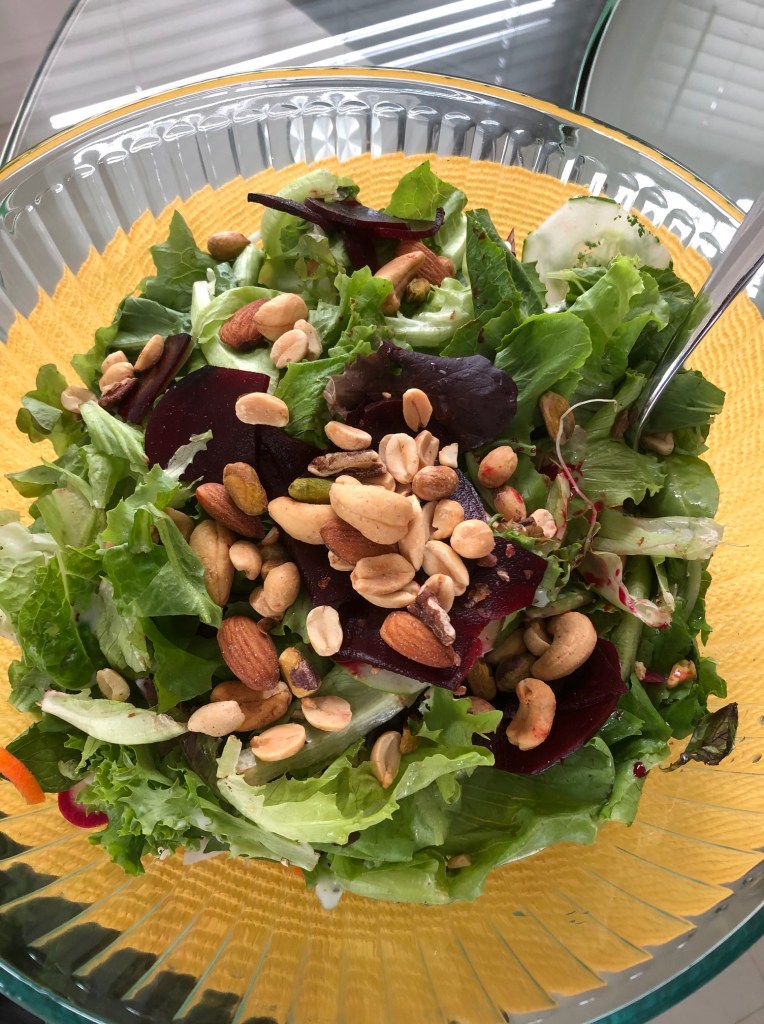
Today’s lunch salad contained 28 different vegetables, fruits, seeds, nuts, legumes plus black pepper and balsamic vinegar.