All the Steak You Want

After finishing a large steak last night I decided that it was so good I should have another.

Here’s the recipe (from Dr. Fuhrman):

Roasted Cauliflower Steaks
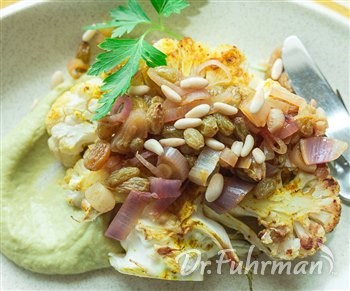

Roasted Cauliflower Steaks

Serves: 2

Slicing a head of cauliflower into large “steaks” is a elegant way of serving this tasty cruciferous vegetable. Season and roast until tender, then serve with a flavorful garbanzo bean puree.

INGREDIENTS:

1 large head cauliflower1/2 teaspoon ground turmeric1 teaspoon Dr. Fuhrman’s MatoZest or no-salt Italian seasoningground pepper, to taste1/4 cup pine nuts or chopped walnuts1/2 cup no-salt-added or low sodium vegetable broth or more as needed1 large shallot, chopped1/4 cup raisins1/2 cup cooked garbanzo beans1/4 cup chopped parsley

INSTRUCTIONS:

Preheat oven to 350 degrees F. 

Cut cauliflower vertically into 1/2-inch thick steaks. You should end up with 2-3 steaks and some extra pieces. Rinse lightly with water and season on both sides with turmeric, no-salt seasoning and pepper. Place steaks and small pieces on a lightly-oiled baking dish, cover with foil and bake for 25-30 minutes or until lightly browned and tender, turning after 15 minutes. Remove small pieces of cauliflower and return steaks to the oven with the heat turned off to keep warm.

Meanwhile, in a saute pan, saute pine nuts or walnuts until lightly toasted. Remove from pan and set aside. Add shallots to the pan along with 2 tablespoons of vegetable broth and saute for 2-3 minutes or until starting to become translucent. Add raisins and cook until raisins become plump, adding broth as needed to keep them moist.

In a high-powered blender, blend the small cauliflower pieces, 1/2 of the pine nuts or walnuts, 1/2 of the raisin mixture, the garbanzo beans, 1/2 of the parsley and enough broth to provide a smooth puree.

Transfer puree to a serving platter, place cauliflower steaks on top of puree and garnish with the remaining nuts, raisin mixture and parsley.

Calories 361; Protein 15 g; Carbohydrates 53 g; Sugars 22 g; Total Fat 14.1 g; Saturated Fat 1.2 g; Cholesterol 0 mg; Sodium 173 mg; Fiber 13.7 g; Beta-Carotene 389 ug; Vitamin C 215 mg; Calcium 151 mg; Iron 5.3 mg; Folate 337 ug; Magnesium 141 mg; Potassium 1702 mg; Zinc 3.1 mg; Selenium 4.5 ug

Grain Brain

When discussing celiac disease I mentioned that the book Grain Brain by Perlmutter advocated no gluten or whole grains for anyone, celiac or not. David Katz commented that this was ridiculous since the medical literature strongly confirms health benefits for whole grains. Because this book continues to be widely read and cited by low carb advocates I purchased a copy and read it. The following is the review I sent to Amazon:

I have rarely read a book that made me so angry.

It’s probably good to say who I am: a retired physician (diagnostic radiologist) whose retirement project has been studying nutrition and its effect on health for the past 15+ years.

The message of this book is that a low carbohydrate, high fat diet promotes brain and overall health primarily by keeping blood sugar and insulin low and controlling systemic inflammation. The diet advocated will help most people manage blood sugar and decrease inflammation for most who are eating a standard American diet (SAD).

Sugar and processed carbs are vilified; no argument since they are not healthy. But unrefined grains and whole plant food starches are given the same label. Interesting, since epidemiological studies uniformly find that large groups of people whose major calorie source is these foods live the longest and have the least chronic disease. The absolutely proven healthy diet is one that is exclusively or mainly whole plant foods including whole grains.

Since this diet avoids processed carbs and starches it will be calorie restricted for most people who will lose weight and have less inflammation. Perlmutter tells his readers that they can usually get their CRP (a commonly used lab test measuring inflammation) to less than 3 after a month or so. On a whole food plant based diet (WFPB) mine is 0.4 which is about par for people eating this way.

Many eating the Grain Brain diet will end up with high serum cholesterol but the author tells us that this is not only OK but good, citing some irrelevant references (too detailed a topic to cover in a review.)

Atherosclerosis, which causes most heart attacks and strokes, is barely covered, on one page mentioned as something everyone gets no matter what the diet. This is absurd which I’m sure the author must know. Many people do not get atherosclerosis- those who have eaten a WFPB diet their whole lives. Those who change to this diet reverse atherosclerosis. A WFPB is the only well-proven way to treat atherosclerosis, still the number one killer of Americans.

Cancer gets a few passing references. Since overweight people get more cancer the author assumes they will get less cancer in spite of many studies associating animal protein consumption, a mainstay of a Grain Brain diet, with more cancer.

The book does advocate eating non-starchy vegetables which is undoubtably a good idea but is unlikely to make up for the other bad advice.

It’s frightening to contemplate the number of people whose health has been damaged by this best selling book. I do understand that the author has made a lot of money from the book and other related projects: the American dream (nightmare) to create a very profitable business no matter the effect on health or societal welfare.